For a PDF of this article, click here.
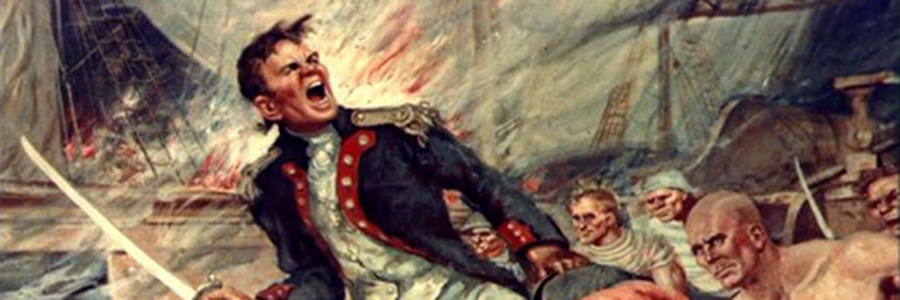
Deep wisdom directed at today’s leaders isn’t what you’d expect from a guy who’s been dead since 1792. But Captain John Paul Jones, having been successfully channeled by Rear Admiral Rob Wray, has stern advice for today’s officers of the American Navy.
Do you agree with him? And, does his advice apply to other leaders? Leave us a comment and tell us what you think.
MEMORANDUM
From: John Paul Jones, Captain
To: Officers of the American Navy
Subject: Standards of Virtue and Honor
Date: July 4, 2011
Officers and Commanders of Navy units!
Two hundred and thirty-five years ago, when I was in uniform, the Continental Congress established in Navy Regulations their expectations for American naval officers. They wrote (as I remember), “the commanders and officers of American ships and vessels are strictly required to show themselves a good example of honor and virtue to their crew...”
At the wardroom table, my officers asked me what I believed to be the standard of honor and virtue. What did I expect from my officers, specifically? I believed then, and believe now, that being honorable and virtuous requires two things: the intellectual understanding of the specific actions and attitudes that comprise honor and virtue, and the moral resolve to display those actions and attitudes. So I wrote for my officers the following definition:
“It is by no means enough that an officer of the navy should be a capable mariner. He must be that, of course, but also a great deal more. He should be as well a gentleman of liberal education, refined manners, punctilious courtesy, and the nicest sense of personal honor.... He should be the soul of tact, patience, justice, firmness, and charity. No meritorious act of a subordinate should escape his attention or be left to pass without its reward, even if the reward is only a word of approval. Conversely, he should not be blind to a single fault in any subordinate, though, at the same time, he should be quick and unfailing to distinguish error from malice, thoughtlessness from incompetency, and well-meant shortcoming from heedless or stupid blunder.
In one word, every commander should keep constantly before him the great truth, that to be well obeyed, he must be perfectly esteemed.”
Much time has passed, and my days serving our flag in uniform are long gone. Ships and weapons have changed in ways I never thought possible. But the requirement for virtue and honor has not. No leader can lead without the esteem and respect of those led. As a result, I have been asked to come back to write to you, today, to pass on what I view as a modern definition of virtuous and honorable behavior.*
First, my expectations for all officers:
Officers must be, above all, scrupulously honest. They must always tell the truth, regardless of the personal or professional consequences. Honesty cannot be turned on or off. Once sacrificed, it can never be regained. The smallest of white lies cannot be tolerated, for any reason, because the mind, over years, can learn to justify larger and larger transgressions. The slippery slope applies; stay away from the edge. If I ever detect any hint of dishonesty in any of my officers, they are escorted off the ship at the next port; it is the only inviolate rule. Dishonesty can include sins of commission (telling a lie), and sins of omission (failing to disclose important information, usually to protect oneself). Both are lies. Do not lie to yourself in pitiable rationalizations about why you are not being forthright.
Officers must, in all cases, set the example. They must look smart and professional; they should be well-groomed. They must be in good physical condition, not only to perform their duties, but to set the example. A portly officer cannot urge his men to be fit to do their duties, because his men will smell the stink of hypocrisy. They should have clean, sharp uniforms; they should stand upright and erect; they should not slouch with hands in pockets; they should set the example of what the crew wants an officer to be. All followers want to look up to their leaders; leaders should take care not to disappoint.
Officers should be courteous, to each other, and to those outside the ship. They should speak softly, clearly, without the need for profanity or volume to make themselves heard. They should be able to sit at a table with royalty, and not embarrass the service through poor manners, speaking with mouths full, inability to use silverware, and the like. They should not speak disparagingly of others. They should not gossip. Coarse, slovenly, unkempt, flatulent, ungainly, inconsiderate, inappropriate, discourteous—these terms should never be used to describe any officer with whom I would associate.
Officers must genuinely, sincerely, care for the crew...
Officers must be brave, not only physically, but morally...
Officers today face complex social situations I never faced—mixed gender crews...
Officers will value their honor and their virtue more than money...
Good officers are calm...
A good officer will never drink to excess...
Good officers will not speak ill of the service...
Officers must know their trade...
Competence generates confidence in the men...
A good officer knows his people by their name...
Good officers must persevere!...
Finally, a good officer will study his trade...
Officers! As I said before...
Second, my expectations for Commanding Officers:
As a fathom is to a foot...
A good Commander will, immediately upon taking command...
A good Commander will write himself a private letter...
A good Commander will sit with his senior officers...
A good Commander will have read all the guidance...
A good Commander is transparent...
A good Commander teaches...
A good Commander shows up at social events...
A good Commander never, ever...
A good Commander never profits...
A good Commander leads a clean life...
A good Commander takes care...
A good Commander never demands loyalty...
Finally, a good Commander puts his crew first...
How to acquire virtuous values:
Some may say that my views...
I said before: virtue and honor...
That conviction is not in-borne...
You are an American naval officer...
"These are the times that try men's souls..."
I pray that you will resolve...
JPJ
*Because I am unable to operate the computer...
(Reprinted with permission.)
Published: August 29, 2015


Ramon David Baker MD
This was a very uplifting read. I am a retired physician with avocation in classical violin. As a former naval medical officer, I always had an appreciation of the tenets held by John Paul Jones. In the course of my career, I practiced medicine in several venues, and ended with 25 years in private practice. After I retired, I worked for a few years more in two other settings. Medicine remains both an interest and a discipline, hopefully a stimulant for continued curiosity and some humble satisfaction. thank you for this essay on John Paul Jones. I look forward to finding more on the achievements of President Calvin Coolidge, whose extraordinary accomplishments of minimal interference were associated with such profound developments in America during the decade of the 1920s.